
February 4th, 2026
—
Why the Shift from Employee to ISO Consultant is More About Perspective Than Experience
I was asked a really good question recently by someone transitioning from an employee role into ISO consulting. They’d had solid experience in the industry, worked across systems, conducted audits, guided teams, and delivered real outcomes, but they stopped and said, “I get all that… but how do I build my credibility as a consultant?”
That question stuck with me, because it comes up a lot.
What struck me was that their knowledge and experience had not suddenly disappeared the moment they stopped being an employee. The impact they’d been having didn’t suddenly stop counting just because their employment type or title was changing.
In reality, they’d already been consulting for years, just without calling it that.
When you’re an employee, you guide teams, influence decisions, interpret standards, support implementation, and help the organisation move forward. You diagnose problems, recommend approaches, and adjust based on context. That IS consulting – it just happens internally.
The shift into external consulting isn’t about inventing credibility. It’s about reframing your experience.
If you looked at your employee role as if you were already a consultant, very little would actually change. The main difference is that, as a consultant, you often guide more and do a little less, because ownership needs to sit with the client. But the thinking, decision-making, and experience behind your advice are already there.
Your credibility doesn’t start the day you register a business or update your LinkedIn headline. It’s built on the work you’ve already done, the problems you’ve solved, and the outcomes you’ve supported over time.
Sometimes the real work isn’t building credibility at all but recognising that you already have it and learning how to stand in it confidently.
Think of it like changing seats, not changing vehicles.
You’re still driving the same experience, judgment, and capability. You’ve just moved from the passenger seat inside the organisation to the driver’s seat beside the client.
When people step out of an internal role and into consulting, they often feel like they’re starting from zero. That’s an illusion. What they’ve been doing inside organisations – guiding teams, interpreting standards, influencing decisions – is exactly the work that creates credibility.
In the Harvard Business Review article Successful Leaders Are Great Coaches they highlight that the most effective leaders are those who coach rather than command, because credibility isn’t built on title but on the ability to help others think through tough problems and reach their own solutions. This reframes credibility from a badge you earn in your new business to the muscle you’ve already been developing throughout your career.
Seeing Your Credibility Differently
When you step back and look at the work itself, the difference between being an employee and being a consultant isn’t nearly as dramatic as it feels. The core capability stays the same. The judgment, the thinking, the influence, and the way decisions are shaped don’t suddenly reset. What shifts is where that work sits and how responsibility is held, not the credibility behind it.
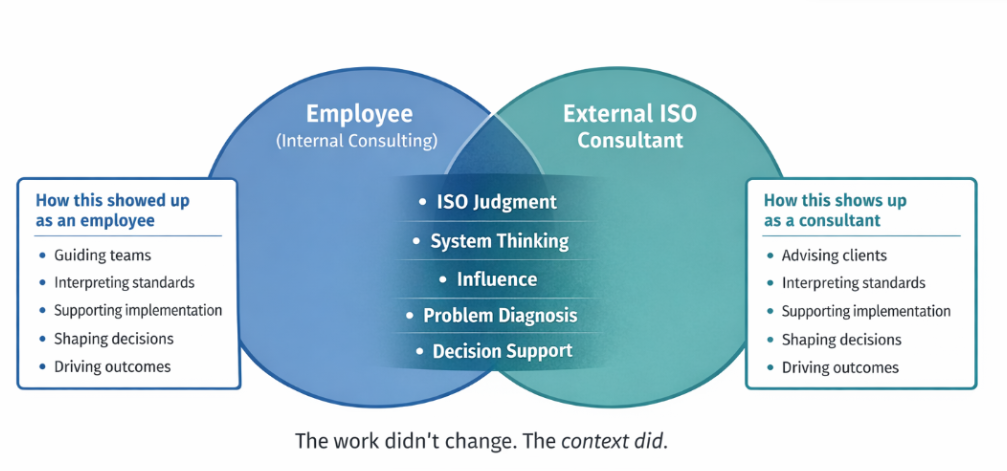
What this highlights is that credibility doesn’t live in the job title or the business structure. It lives in applied ISO thinking. The ability to interpret requirements in context, recognise patterns across systems, and guide decisions that actually move the organisation forward doesn’t suddenly appear when someone becomes a consultant. It’s built over time, through real situations, and real outcomes.
Next Steps for You
- Audit your own experience.
List the situations where you’ve guided decisions, interpreted standards in context, supported implementation, or helped teams move forward. Look at those examples through a consulting lens, not an employee one. - Practice owning your capability in language.
Start describing your work in terms of outcomes and influence rather than tasks and titles. This is how credibility becomes visible to others and believable to yourself. - Shift how you show up, not what you know.
Consulting is less about doing the work and more about guiding the thinking. Create space for others to own decisions while you support the direction.



View comments
+ Leave a comment