
February 25th, 2026
—
How to build your consulting direction while still employed
For years, I carried a notebook everywhere with me.
It was at work, sitting beside my keyboard. It was in my handbag when I went out for coffee. It lived in the car. If an idea came to me, it went straight into that notebook. There are pages in there that don’t make much sense now, half sentences, arrows pointing in different directions, ideas that never went anywhere, and others that became the foundation of what I do today.
I didn’t have a formal plan. I didn’t even have a clear business model. What I had was a consistent thought in the background that I wanted to build something of my own one day.
The important part is this: I was still employed the entire time.
I wasn’t plotting an exit. I wasn’t secretly registering businesses. I wasn’t burning bridges. I was simply thinking ahead.
At some point, I stopped asking myself whether I would do it and started asking a better question.
If I’m still here in six months, what can I build now that strengthens both my employer and my future direction?
That question changed the tone completely.
Instead of feeling stuck, I felt deliberate. Instead of feeling impatient, I felt strategic. The notebook wasn’t about escaping my role; it was about preparing properly while I was still in it.
When you’re still employed, you are sharpening the axe. Most people want to swing the axe immediately. Very few are willing to sharpen it first. Building your consulting direction while still employed is the sharpening stage. It’s quiet, deliberate, and often underestimated, but it is what makes the eventual move sustainable.
The Forbes article Launch Your Future Consulting Career In 6 Steps (Before Quitting Your Day Job) reinforces the same idea. It encourages professionals to begin building visibility and credibility while still employed. Some of the examples are large-scale, like publishing a book, but the principle underneath it is simple: start becoming known for your expertise before you need it. In practice, that might mean sharing your insights, contributing to conversations, or articulating your experience more deliberately. It doesn’t require a grand launch. It requires consistency.
This Starts With a Different Way of Thinking
Over time, I realised there was a pattern to this. Building toward consulting while still employed isn’t random, and it isn’t rushed. It follows a sequence. When you approach it deliberately, there are clear stages that move you from preparation to controlled transition.
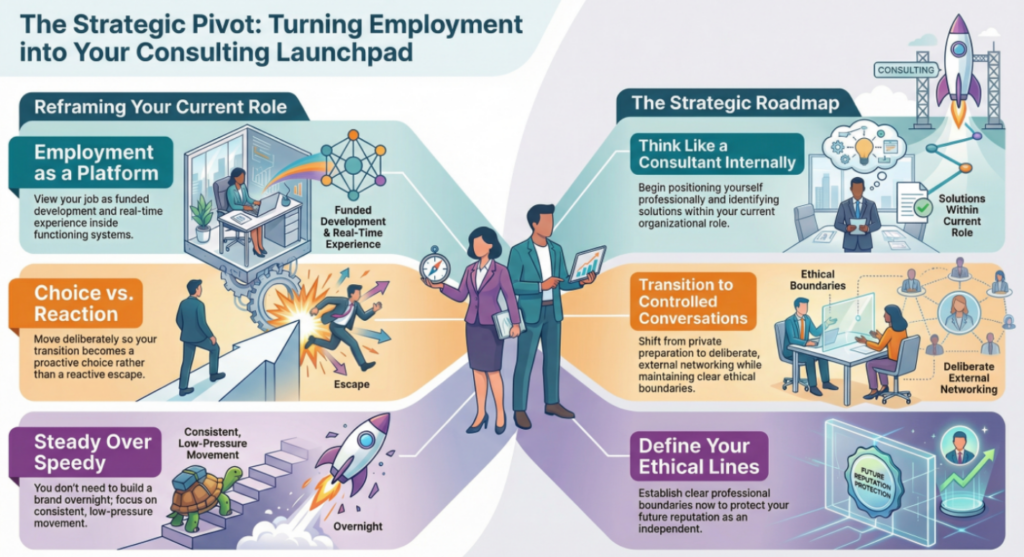
Each of these stages builds on the one before it. None of them require you to resign, register a business, or make a public declaration. They require you to shift how you see your current role, how you position your experience, and how deliberately you move.
The mistake most people make is trying to jump straight to the right-hand side of that framework. They want conversations, clients, and momentum before they’ve reframed their employment or defined their ethical lines. That’s when frustration and tension appear.
When approached in sequence, the transition feels controlled rather than reactive.
Next Steps for You
- Reframe your current role.
Before you do anything visible, change how you see your employment. Stop viewing it as the thing in the way and start viewing it as funded development. Ask yourself where you are gaining exposure, capability, and pattern recognition that will matter later. - Strengthen your professional positioning.
Look at how you describe your experience, particularly online. Does your LinkedIn profile simply list responsibilities, or does it reflect the problems you solve and the improvements you’ve supported? Small shifts in how you articulate your work begin shaping how others perceive your expertise. From there, start contributing thoughtfully to conversations in your field. Share reflections, comment on industry changes, or highlight lessons from projects without breaching confidentiality. Visibility doesn’t require bold announcements. It requires consistency. - Take one deliberate, low-pressure action.
That might be sharing a professional reflection, having a conversation with a trusted contact about your direction, or volunteering for a stretch project in your current role. It doesn’t need to be public or dramatic. It needs to be intentional.
If you’ve been carrying your own version of that notebook and thinking about consulting,
From Employee to ISO Consultant was designed for exactly that stage.
It’s a complimentary, self-paced course that gives structure to what can otherwise feel vague and uncertain.


View comments
+ Leave a comment